
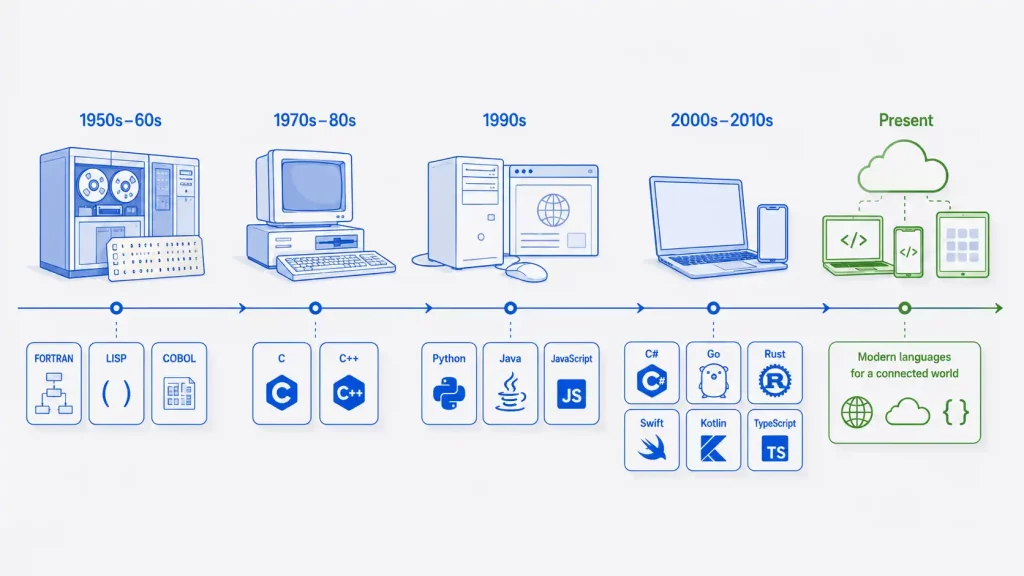
Every programming language was born to solve a problem its creators found unsolved. Some, like FORTRAN and COBOL, were built to make early computers usable for science and business. Others, like C, Python, and Rust, reshaped how software is written for entire generations of developers.
This guide traces the history of the most influential programming languages — who created each one, when, and why — from the pioneers of the 1950s through the modern languages driving development today. Whether you’re curious about the origins of the language you use every day or exploring how the field evolved, this is the story behind the code. This guide is part of our broader collection of programming tutorials, covering the languages, tools, and concepts behind modern software development.
Programming Languages Timeline: Creators and Origins
| Language | Year | Creator(s) | Created For |
|---|---|---|---|
| FORTRAN | 1957 | John Backus (IBM) | Scientific & mathematical computing |
| LISP | 1958 | John McCarthy | Artificial intelligence research |
| COBOL | 1959 | Grace Hopper & committee | Business data processing |
| BASIC | 1964 | Kemeny & Kurtz | Teaching beginners |
| Pascal | 1970 | Niklaus Wirth | Teaching structured programming |
| C | 1972 | Dennis Ritchie | Systems programming (UNIX) |
| C++ | 1985 | Bjarne Stroustrup | C with object orientation |
| Perl | 1987 | Larry Wall | Text processing & scripting |
| Python | 1991 | Guido van Rossum | Readable, general-purpose code |
| R | 1993 | Ross Ihaka & Robert Gentleman | Statistical computing & data analysis |
| PHP | 1994 | Rasmus Lerdorf | Dynamic web pages |
| Java | 1995 | James Gosling (Sun) | “Write once, run anywhere” |
| JavaScript | 1995 | Brendan Eich (Netscape) | Interactive web pages |
| C# | 2000 | Anders Hejlsberg (Microsoft) | .NET application development |
| Go | 2009 | Griesemer, Pike, Thompson (Google) | Simple, fast systems & networking |
| Rust | 2010 | Graydon Hoare (Mozilla) | Memory-safe systems programming |
| Kotlin | 2011 | JetBrains | A better Java for the JVM |
| TypeScript | 2012 | Anders Hejlsberg (Microsoft) | Typed JavaScript at scale |
| Swift | 2014 | Chris Lattner (Apple) | Modern, safe Apple development |
The pattern across seven decades is consistent: each language emerged because existing tools couldn’t meet a new need — new hardware, the web, mobile, or safer systems code.
1. JavaScript
JavaScript is a high-level programming language used for creating interactive web pages and web applications. It was developed by Brendan Eich at Netscape in 1995 and has since become one of the most popular programming languages in the world. It powers most of the websites on internet as client side scripting language.
It is the most popular programming language in the world and requires some other skills to properly implement it such as HTML and CSS to define the content and layout of web pages.
JavaScript is mainly used for client-side scripting in Web development, Web frameworks, Mobile development, Server-side scripting and Internet of Things (IoT).
2. C++ Programming Language
The C++ programming language is widely used in the software development industry. Some of its application domains include systems software, operating systems, device drivers, embedded software, high-performance server and client applications, and entertainment software such as video games.
The C++ programming language was designed and implemented by Bjarne Stroustrup in 1985 (First edition). Stroustrup was born in Aarhus Denmark in 1950. He did his Ph. D. in computer science in 1979 from Cambridge University, England. He is the College of Engineering Chair in Computer Science Professor at Texas A&M University.
C++ is used for Game Development, High Performing Computing, Computer Graphics and in Financial Systems.
Today C++ remains one of the most widely used languages for performance-critical software — you can explore it further in our C++ programming tutorials. If you’d like to start writing C++ yourself, our complete guide to C++ programming basics walks you through it from scratch.
3. Java Programming Language
The Java programming language is based on the syntax of C and C++ but has a simpler object model. Though it provides very little lower level functionality. Java is a modern, object-oriented language designed to run on any platform via the Java Virtual Machine. Java was originally developed by James Gosling at Sun Microsystems and released as a core component of Sun Microsystems’ Java platform.
James A. Gosling began designing Java in the early 1990s, and it was released in 1995. He did the original design of Java and implemented its original compiler and virtual machine. For this achievement he was elected to the United States National Academy of Engineering.
Java is mainly used to develop Enterprise Applications, Web and Mobile Applications, Cloud Computing and Big Data.
4. Python Programming Language
The Python Programming Language is an interpreted, object-oriented, high-level programming language with dynamic semantics. It is designed with the aim to increase programmer’s productivity and ease in use. Python provides multiple programming paradigms and provides easy extensibility.
Created in 1991, Python is now one of the world’s most popular languages, dominant in data science, AI, web development, and automation.
The Python was designed and developed by Guido van Rossum who is a Dutch computer programmer.
5. R Programming Language
R is a programming language for statistical computation, quantitative analysis and graphics. It compiles/runs on a wide variety of UNIX platforms, Windows and MacOS. R was initially designed by Ross Ihaka and Robert Gentleman and developed by R Core Team.
R is a free and integrated software development environment which provides facilities for data manipulation, calculation and graphical display. It is not an environment within which statistical techniques are implemented but it can be easily extended further via packages.
Mainly R is used for statistical Computing and Data Analysis, Research, Data Science and developing Machine learning models and algorithms.
6. Swift Programming Language
Swift is Apple’s modern language for iOS, macOS, and its other platforms, introduced in 2014 and led by Chris Lattner. Designed as a safer, faster successor to Objective-C, it removes entire categories of unsafe code while staying approachable.
Swift is used for iOS, macOS, watchOS, and tvOS app development, and increasingly for server-side Swift.
7. Go Programming Language
Go is a general purpose, open source and statically typed programming language developed at Google. It was designed by Robert Griesemer, Rob Pike, and Ken Thompson. It is sometime referred as “Golang”.
It is mainly influenced by C with emphasis on simplicity and safety. It was designed to keep useful features from other programming languages such as static-typing and run-time efficiency (C++), readability and usability (Python or JavaScript) and high-performance networking and multiprocessing.
Golang is used for System-level programming, Network applications, Cloud-native applications, DevOps automation and Data processing.
8. Rust Programming Language
Rust is a systems programming language focused on safety, speed, and concurrency. It was created by Graydon Hoare at Mozilla starting in 2010, designed to give the low-level control of C and C++ while preventing entire classes of memory-safety bugs at compile time through its ownership system. Rust has topped Stack Overflow’s “most admired language” survey for years running.
Rust is used for systems programming, WebAssembly, game engines, embedded systems, and performance-critical backend services.
9. Kotlin Programming Language
Kotlin is a modern, statically typed language created by JetBrains in 2011. It runs on the Java Virtual Machine and interoperates fully with Java, but with more concise, safer syntax. In 2019, Google made Kotlin its preferred language for Android development, cementing its popularity.
Kotlin is used for Android development, server-side applications, and cross-platform mobile development.
10. TypeScript Programming Language
TypeScript is a superset of JavaScript that adds static typing, created by Anders Hejlsberg at Microsoft in 2012 — the same architect behind C#. It compiles to plain JavaScript but catches type errors during development, which is why it’s become the default for large-scale web applications.
TypeScript is used for large web applications, front-end frameworks (Angular, React), and Node.js backends.
11. C# Programming Language
C# Programming language is the choice for .NET Framework. The syntax of C# is similar to Java Programming language. Anders Hejlsberg, a lead architect at Microsoft, designed C# in 2000.
It is a general purpose and modern object oriented programming language. It is a type safe and component-oriented programming language. Some of the unique features of C# are nullable types, LINQ and Lambda Expressions.
C# is generally used to develop Windows desktop applications, Windows services, Web applications, Mobile applications and Game Development.
12. PHP Internet Programming Language
PHP is the most widely used server-side scripting language. People use PHP to develop dynamic and data driven websites and web applications. It is an open source programming language developed by Rasmus Lerdorf in 1994.
As of 2026, PHP powers roughly 75% of websites whose server-side language is known (W3Techs). A content management system WordPress, written in PHP, powers ~43% of the websites on the internet.
PHP is mainly used for Web Development, Server-side scripting, Command-line scripting and developing Content Management Systems.
13. Pascal Programming Language
The Pascal programming language was originally designed and implemented to teach students structured programming. Pascal was notably used in the early software for the Apple Lisa and Macintosh. Pascal has successors, Modula and Oberon, which add module and access to system resources.
The language was designed in 1970 by Nicklaus Wirth to impose programmers a structured programming style. Niklaus Emil Wirth was born in 1934 in Switzerland. He did his degree in Electronics Engineering in 1959 and in 1963 he was awarded a Ph.D.in EECS from the University of California.
Pascal is generally used for Education, Scientific Computing, System Programming and Database programming.
14. Perl Programming Language
The Perl Programming Language is a stable, cross platform programming language. Perl is a great language for processing text and automating tasks. It is used for mission critical projects in the public and private sectors and is widely used to program web applications of all needs. Larry Wall designed and developed Perl programming language in 1987.
Perl is best used for Text processing, Bioinformatics, Automation and scripting, System administration and web development.
15. C Programming Language
The C programming language is a computer programming language originally developed in 1972 by Dennis Ritchie at the Bell Telephone Laboratories to implement the UNIX operating system. Some of its application domains include device drivers, hardware interfacing and embedded system development.
Dennis MacAlistair Ritchie was born September 9, 1941. Dennis is an American computer scientist notable for his influence on C and other programming languages, and on operating systems such as Multics and UNIX. He received the Turing Award in 1983 and the National Medal of Technology in 1998.
C programming language is mainly used in operating systems, embedded systems, compilers, network applications.
16. Basic Programming Language
The Basic Programming Language (Beginner’s All-purpose Symbolic Instruction Code) is a very powerful language as a tool for the novice programmers. Some of its main features include easy learning for new programmers, designed for interactive use rather than batch work and is therefore suitable for both the professional and non-professional.
The programming language was invented in 1964 by Kemeny and Kurtz. John George Kemeny was born in Hungary on May 31, 1926, and immigrated to the United States with his parents in 1940. Thomas Eugene Kurtz, born in 1928, is an American computer scientist.
Usage of Basic in professional and commercial applications has declined over time in favor of other programming languages.
17. COBOL Programming Language
The COBOL Programming Language (Common Business Oriented Language) is one of the oldest programming languages still in active use. The application domains include business applications, finance, and administrative systems for large corporate, companies and governments.
COBOL was designed by a committee (CODASYL) whose members included Grace Hopper, Jean E. Sammet, and others.
COBOL has been used in Financial systems, Data and Batch processing, Government systems and maintenance of Legacy systems.
18. FORTRAN Programming Language
The FORTRAN Programming Language (Formula Translation) was developed by a team of programmers at IBM led by John Backus and was first published in 1957. This is one of the oldest programming languages specifically designed for easy translation of mathematical and statistical formulas into code.
Application domains of FORTRAN include mathematics, scientific formulas translation, statistical and engineering related application development.
FORTRAN has been used in Scientific and engineering applications, Aerospace and defense, Computational chemistry and Financial analysis. While its usage has declined over time, FORTRAN remains an important language for many scientific and engineering applications.
19. Lisp Programming Language
The Lisp Programming Language (or LISP) is a general programming language specially designed for Artificial Intelligence applications. Application areas include Artificial Intelligence, Robots, Computer games, pattern recognition, defense systems and tree traversal.
John McCarthy developed Lisp in 1958; his interest in AI traced back to the 1956 Dartmouth Summer Research Project on Artificial Intelligence. John McCarthy was born in 1927, did a B.S. in Mathematics in 1948, McCarthy initially continued his studies at Caltech. He received a Ph.D. in Mathematics from Princeton University in 1951.
Some of the main uses of Lisp include Artificial intelligence, Symbolic computing, Education, Prototyping and Game development. LISP still remains an important language for many artificial intelligence and symbolic computing applications.
Which of These Languages Are Most Used Today?
Language popularity shifts constantly, but industry indexes give a reliable picture. As of 2026, the TIOBE Index and the Stack Overflow Developer Survey consistently place Python, C++, C, Java, C#, and JavaScript among the most widely used languages, with Python frequently at the top driven by data science and AI. Among newer languages, Rust, Go, and TypeScript show the strongest sustained growth. The historical languages here — FORTRAN, COBOL, Lisp — see far less new development but remain critical in the scientific, financial, and legacy systems they were built for. To see how these languages are applied in practice, take a look at the programming languages behind the most popular websites.
Frequently Asked Questions
Conclusion
The history of programming languages is really a history of problem-solving. Each language here was created because the tools of its time couldn’t do something its inventors needed — whether that was making early computers usable, powering the web, building mobile apps, or writing safer systems code. That lineage is why understanding a language’s origins tells you so much about how it works today.
The field keeps evolving. FORTRAN and C proved that high-level languages could be both powerful and practical; Python and JavaScript made programming accessible to millions; and newer languages like Rust, Go, and TypeScript are shaping what comes next. Whichever language you work in, you’re building on more than seventy years of ideas passed from one generation of programmers to the next.